
From Procurement to Profitability: What the Mountain West's Renewable Developers Are Telling Us About Supply Chain Risk
At the Mountain West Renewables conference in Salt Lake City, I moderated a panel that drew an attentive room right before lunch, and for good reason. "From Procurement to Profitability: Managing Supply Chain Risk in the Mountain West" tackled a topic that used to be a "sleeper" issue in renewable development. But that is now changing — between FEOC restrictions, domestic content rules, tariff volatility, and labor constraints, supply chain strategy has become a frontline determinant of whether a project gets built, when it gets built, and what it ultimately returns to investors. I was joined by:
Jason Espersen (General Counsel, rPlus Energies)
Katie Alexandridis (Director of Engineering & Procurement, Nova Clean Energy)
John Kapral (Senior Director, Renewable Energy Tax Incentives & Credits, Walker Blue)
Jacqueline de Fresart (Associate Director, Origination & Power Marketing, EDF Power Solutions North America)
Erin Walkowiak (VP, Preconstruction, Elevate Renewables)
The panel opened on FEOC restrictions and the whiplash pace of new federal policy, which panelists agreed is forcing constant re-review of project risk profiles, sometimes at the expense of the most economically optimal procurement decision. Lenders and tax equity investors are scrutinizing compliance risk closely, pushing developers to build the latest "best practices" and material assistance language into contracts rather than relying on boilerplate. But panelists were candid that pushing risk downstream to suppliers and EPCs only goes so far: contracts that look airtight on paper still depend on whether a supplier will actually stand behind those provisions when it counts. The consensus was that connecting the dots — from procurement, through tax equity, to financing — is no longer optional. A project sourced on price alone, without documentation that satisfies lenders' diligence requirements, will struggle to get to the finish line.
On domestic content, the panel described a real evolution. Early in the Inflation Reduction Act era, verifying domestic content eligibility was, in one panelist's words, a "nightmare" — manufacturers were reluctant to share proprietary costing data, and developers often fell back on Build America, Buy America documentation just to have something reliable to point to. Now, manufacturers now see themselves as stakeholders in the process and are proactively offering certifications and opening their books under NDA. Procurement teams are also engaging suppliers years earlier than they used to, vetting traceability and sourcing transparency long before an RFP goes out, a shift Alexandridis and others described as essential "ground game." Interestingly, nonprofit and public-sector clients, such as school districts and university campuses facing a 2026 mandate that ties their tax credit eligibility directly to domestic content compliance, are emerging as some of the most demanding voices pushing the industry toward better documentation standards.
Tariffs added another layer of uncertainty. Panelists pointed to newly announced duties, including a fresh round affecting Canadian-sourced steel and piping used in geothermal projects, as evidence that pricing volatility isn't slowing down. Developers are trying to push tariff risk onto suppliers where possible, but acknowledged that not every supplier will absorb it, and that contracts increasingly need built-in mechanisms to true up pricing if tariffs shift after signing, including protection against retroactive duty clawbacks. Looming over all of this is an August 26 executive order on bulk power systems that panelists described as sweeping but almost entirely undefined — no clarity yet on scope, remedies, or even what "prior to August 26" means in practice. Their practical response: map the bill-of-materials provenance of every project in the portfolio now, lean on long-term relationships with trusted domestic suppliers, and build the cost of uncertainty explicitly into financial models and PPA pricing.
Labor and offtaker dynamics rounded out the discussion. Walkowiak noted that competition for skilled labor across the Mountain West is being intensified by data center and other construction booms and is driving up costs well beyond the pace of the last five to ten years, making prevailing wage and apprenticeship compliance just one piece of a much larger cost equation. On the offtaker side, panelists observed that Mountain West utilities, many of them vertically integrated, have been slower to adapt contract terms than counterparts in other regions, though tariff-adjustable pricing mechanisms with caps are gradually gaining traction as a middle ground that gives both developers and offtakers clarity on maximum exposure.
To close the panel, I asked what would be the “Harvard Business Review” case study of a developer navigating these waters adeptly. The common thread was collaboration: building genuine, non-transactional partnerships with suppliers, bringing tax and compliance expertise in-house or on speed-dial in a way that wasn't standard a decade ago, and being willing to ask hard questions openly with partners and offtakers rather than pretending anyone has a playbook for this environment. As one panelist put it, the developers who will look smart in ten years won't be the ones who guessed right — they'll be the ones who built the relationships and the documentation discipline to adapt as the rules keep changing.
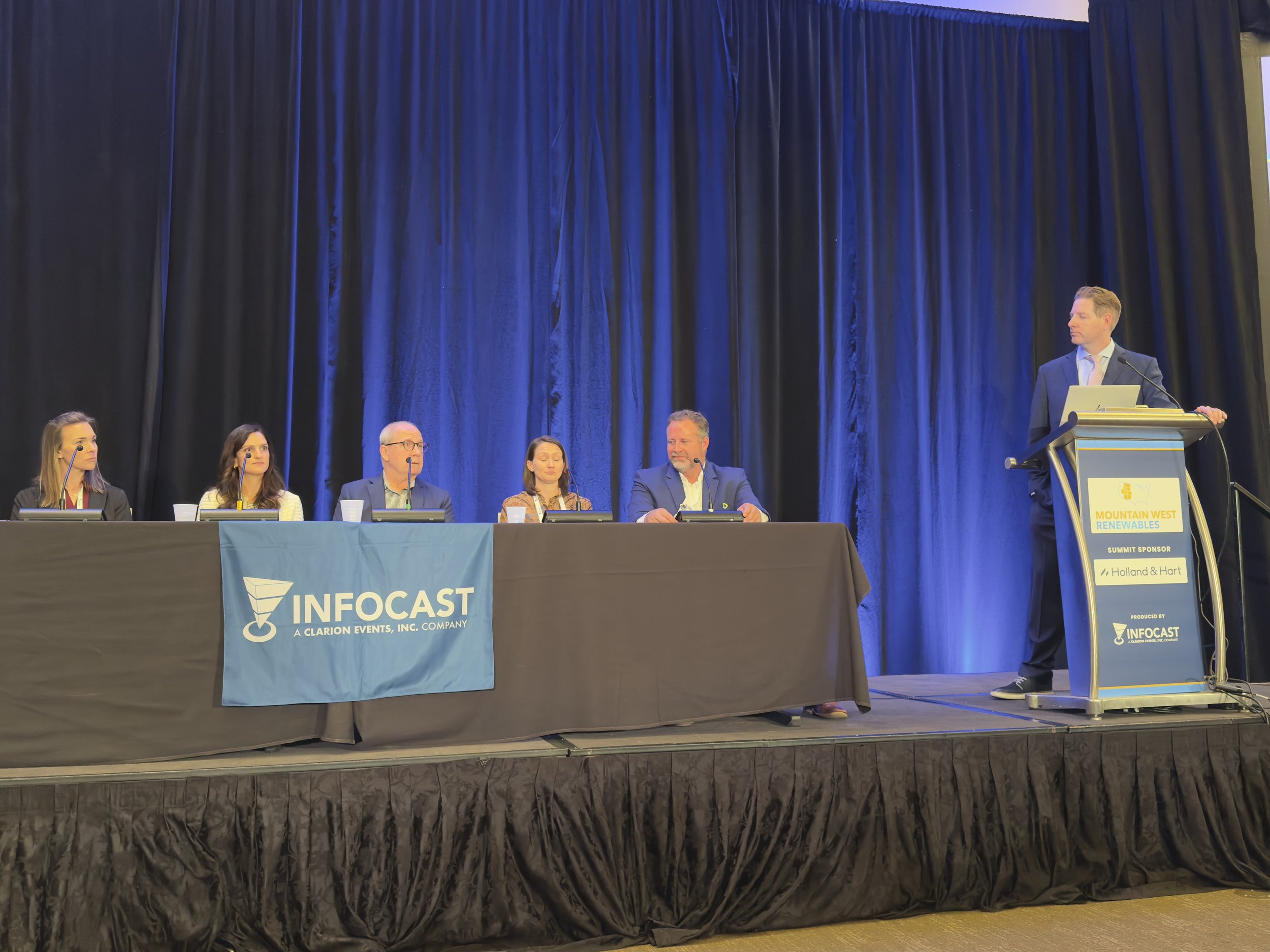
The panelists at Mountain West Renewables Summit.